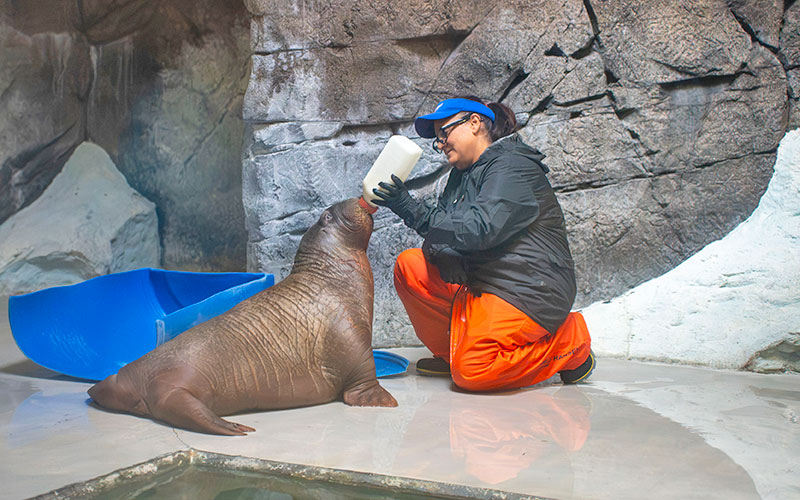
A young Pacific walrus found alone on a remote stretch of northern Alaska coastline has a new home. Annautaq (pronounced “ah-now-tuq”), a five-month-old male calf, has arrived at SeaWorld Orlando after a dramatic rescue and weeks of specialized care at the Alaska SeaLife Center.
At about 220 pounds, he’s already a hefty little guy. He still needs plenty of help, though, and SeaWorld’s animal care and veterinary team is giving him attention around the clock as he settles into his new surroundings. In time, he’ll meet the park’s resident walruses: Uki, Kaboodle and Garfield.
SeaWorld Orlando is one of only four institutions in the United States currently able to house walruses. That makes Annautaq’s arrival a big moment, both for him and for the people who worked together to give him a second chance.
A Rescue Against the Odds
Annautaq’s story begins on a remote beach in northern Alaska. Heavy surf had driven a walrus herd back out to sea, and the calf was left behind.
Violet Anniskett, a wildlife research intern from the local community, and U.S. Geological Survey scientist Tony Fischbach found him there. The orphaned calf was tucked between the old remains of two adult walruses. Scavenging birds had already started to circle, and he was unlikely to survive on his own.
Anniskett and Fischbach cared for him over several days. Then, with support from the local community and federal wildlife officials, he was flown to the Alaska SeaLife Center in Seward. Community members backed his rehabilitation, knowing he would stay in human care and could help others learn more about Pacific walruses.
Anniskett also gave the calf his name. Annautaq means “axe” in Iñupiaq, and she chose it to honor her father’s Iñupiaq name. It’s a fitting tribute for a calf whose survival depended on so many caring people.
Specialized Care in Alaska
Once he reached the Alaska SeaLife Center, Annautaq received intensive, species-specific care. SeaWorld sent animal care and veterinary staff with walrus experience to Alaska to work side by side with the center’s team. Together, they helped stabilize him and prepare him for the long trip ahead.
Jane Belovarac, wildlife response curator at the Alaska SeaLife Center, said the rescue highlights how important it is to have this kind of expertise close by.
“Annautaq’s story shows why having specialized marine mammal rehabilitation capacity in Alaska is so important,” Belovarac said. “Our team was able to stabilize Annautaq, support his medical and social needs around the clock and prepare him for the next stage of his care. Getting Annautaq to this point took an incredible network of people.”
Annautaq’s rescue is one chapter in SeaWorld’s long-running rescue mission, which has helped more than 43,000 animals in need.
Why He Couldn’t Return to the Wild
Annautaq responded well to rehabilitation. Still, the U.S. Fish and Wildlife Service determined that he could not be released back into the wild.
The reason comes down to how walrus calves grow up. For their entire first year, Pacific walrus calves live only on their mothers’ milk. Mom also protects them and teaches them the survival and social skills they need. Without her, a young calf like Annautaq simply doesn’t have the tools to make it on his own.
Experts from across the walrus care community worked together to decide where he would thrive best over the long term. They weighed his care needs and, just as importantly, his social needs. SeaWorld Orlando stood out because it offered something essential: the chance to grow up alongside other walruses.

The 4,000-Mile Journey to Florida
With a plan in place, Annautaq made the 4,000-mile journey from Alaska to Orlando. SeaWorld’s team, who had already been caring for him in Seward, helped make sure the trip went smoothly.
Now that he’s arrived, he’s beginning a planned 30-day quarantine. This standard step helps protect the health of the park’s resident animals while giving Annautaq time to adjust.
Around-the-Clock Care in Orlando
Life in quarantine is anything but lonely. Annautaq gets up to six bottle feedings a day, regular veterinary checkups and 24-hour support from his care team.
His bottles hold a special high-fat milk formula. SeaWorld’s veterinary and animal care teams originally developed it to match the rich fat content of natural walrus milk. That extra fat is key for a growing calf who would normally be nursing from his mother.
Jim Kinsler, curator at SeaWorld Orlando, said that food and medical care are only part of the picture.
“At this young age, Annautaq needs more than nutrition and veterinary care. He also needs close contact and companionship, which our expert team is providing around the clock,” Kinsler said. “As he settles in, we’ll make introductions to Garfield, Kaboodle and Uki at his pace.”
Why the Herd Matters So Much
Even the most devoted human caregivers can’t give a walrus everything it needs. Walruses are deeply social animals, and they learn by living with and watching one another. For an orphaned calf, being part of a herd is the best possible outcome, and SeaWorld Orlando can offer exactly that.
Here’s a look at the walruses Annautaq will soon call family:
- Uki, 2: Uki’s story mirrors Annautaq’s. She was also rescued in Alaska and rehabilitated at the Alaska SeaLife Center before moving to SeaWorld Orlando. Today she’s thriving, has a close bond with Kaboodle and loves snow, ice and enrichment activities.
- Kaboodle, 23: An experienced mother, Kaboodle has proven herself as a surrogate to rescued calves, including Uki. Her gentle, nurturing nature will play a big role as Annautaq is slowly introduced to the group.
- Garfield, 44: Garfield was once an orphaned calf in Alaska, too. He was hand-raised at SeaWorld Orlando and is a living example of what a rescued walrus can grow up to be.
Kinsler sees real promise in this group. “Kaboodle’s experience caring for rescued calves and the opportunity to connect with two-year-old Uki, herself a rescued walrus, make this herd a promising setting for him to learn, build relationships and grow,” he said.
An Ambassador for His Species
As Annautaq grows, he’ll join Uki as an ambassador for Pacific walruses. Together, they’ll help guests understand the challenges these animals face in the wild. His journey also reflects SeaWorld Orlando’s broader goal: inspiring people to take action to protect marine life.
When You Can See Him
Annautaq’s care team will decide when he’s ready to meet the herd and when he’ll be visible to the public. Everything will move at his pace.
In the meantime, you can visit SeaWorld Orlando’s resident walruses at the Expedition Odyssey habitat. It’s a great chance to learn about their unique features and strong social bonds and to see how the park supports their care.
Want to follow Annautaq’s progress? Check out SeaWorld (@SeaWorld) and SeaWorld Orlando (@SeaWorldOrlando) on Instagram for updates. For photos and videos from his rescue and early days of care, visit the Alaska SeaLife Center on Instagram (@AlaskaSeaLifeCenter) and Facebook.
From a lonely beach in Alaska to a welcoming herd in Florida, Annautaq’s story is proof of what’s possible when people come together for an animal in need.
Share
Related Articles

SeaWorld Orlando Rescue Helps Transport Rehabilitated Manatees

All-New Expedition Odyssey: Fire & Ice Opens at SeaWorld